Empathy First: What the Philippines Taught Me About Thriving
I went to the Philippines with a question: Why does this country rank third in Harvard University’s Global Human Flourishing Study? I did not go looking for postcard answers. I knew there was poverty. I knew there was political complexity. I knew thriving could not possibly mean an easy life.
What I discovered was something both simpler and harder than I expected.
Thriving is not the absence of struggle. Thriving is not being alone in the struggle.
One evening, I was walking alone along an esplanade at sunset. Families were everywhere — grandparents, teenagers, little kids weaving in and out, music playing, street vendors calling out, and waves of loud, uninhibited laughter. This is halakhak - loud, uninhibited laughter - erupting in waves. It is full-bodied and contagious.
And then I realized something. I was the only person alone. Within minutes, someone asked if I was okay. Another asked if I had a companion. It wasn’t intrusive. It was protective. Being alone registered as unusual. Community was the norm.
That moment has stayed with me.
In the Philippines, suffering is rarely privatized. There is a word — kapwa — that reflects a shared humanity, an understanding that we belong to one another. If something goes wrong, it is not immediately interpreted as personal failure. It is life. It is ours. Others step in. Others know. Others carry.
Contrast that with what we often see here. When hardship becomes private, it becomes shame. When success becomes individual, it can create distance. We quietly carry our burdens and interpret them as evidence that something is wrong with us.
Empathy first interrupts that isolation.
I was also struck by the visible pride — not arrogance, but a grounded confidence. Pride in family. Pride in culture. Pride in faith. It reminded me of Dan Harris’ TED Talk, The Benefits of Not Being a Jerk to Yourself. His message is disarmingly simple: the way we speak to ourselves shapes how we show up in the world.
If my internal dialogue is harsh and critical, that spills outward. If I believe I matter — if I extend compassion inward — I have more capacity to extend it outward.
In the Philippines, a sense of worth is reinforced constantly. Family ties are strong. Faith traditions underscore that you are loved and that your life has meaning. There is encouragement woven into daily life. and a constant messaging that says, "You are part of us." And when that grounding is strong, people seem more inclined to be generous, patient, and helpful. It is strength-based.
At the Momentum Center, we know the damage that “never enough” messaging can do. Many of our members arrive carrying years of negative self-talk. Western messaging can relentlessly whisper, “not enough.” Not attractive enough. Not successful enough. Not smart enough. If self-worth erodes, empathy erodes with it. The spiral moves inward and outward at the same time. Empathy first must begin there — helping people rebuild a relationship with themselves.
There is another word in the Philippines: bayanihan. It describes a community pooling resources when someone is in need. Not pity. Participation. It reminded me of Chezare A. Warren’ powerful distinction between false empathy and true support. False empathy says, “I feel bad for you.” True support says, “I’m with you — and I’ll act.” I saw that lived out over and over again. People checking in. People showing up. People assuming responsibility for one another. Imagine if “Are you okay?” was our default posture. Imagine if no one at the Momentum Center — or in our broader community — ever felt invisible.
There was also a phrase people used with a kind of calm assurance: bahalana — “God will take care.” It is not denial. It is trust. There is something grounding about living with nature, about believing you are held by something larger than yourself, about not borrowing anxiety from a future you cannot control. When fear loosens, empathy grows.
My sabbatical was not about idealizing another country. Poverty is real. Hardship is real. And we must never romanticize suffering.
As I return to the Momentum Center, I am more convinced than ever that empathy first is not soft. It is infrastructure. Spiritual grounding strengthens self-worth. Self-compassion fuels compassion for others. Community reduces shame. Ritual and shared reflection reinforce belonging. We do not flourish alone.
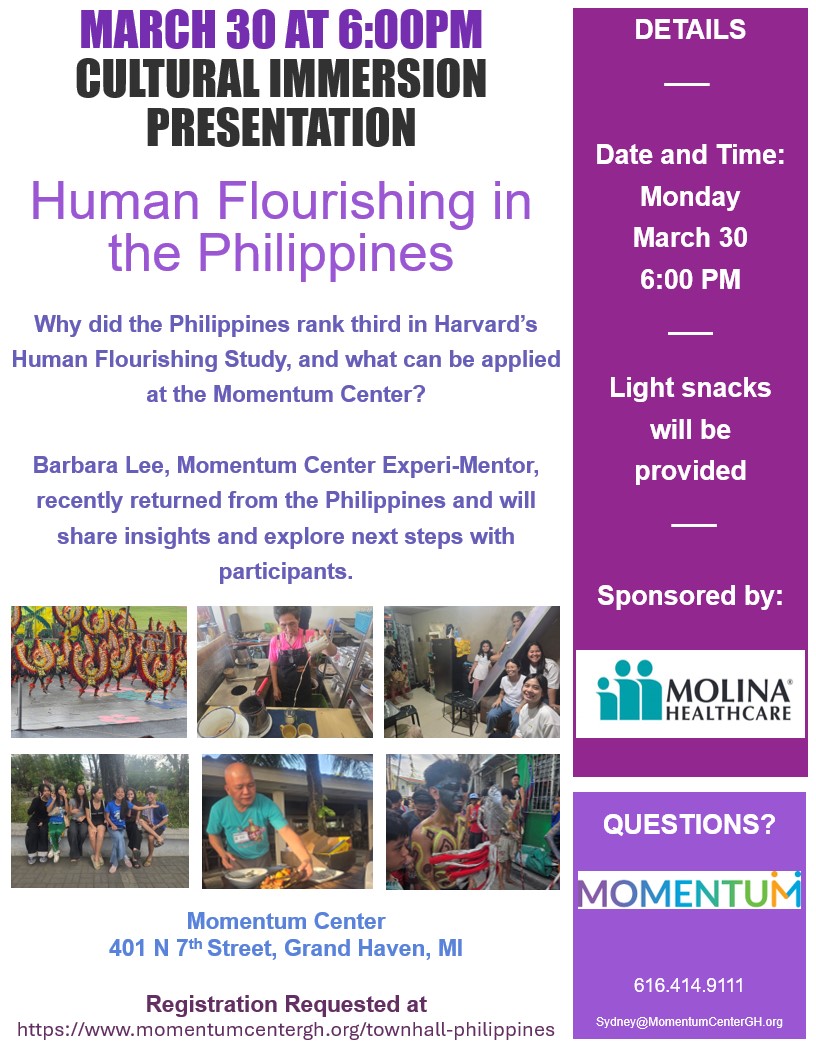
I will be sharing more of these stories, reflections, and what they might mean for us at a Cultural Immersion Conversation at the Momentum Center on Monday, March 30 at 6:00 p.m. It is free and open to anyone who would like to attend. I would love for you to join me.
If the Philippines taught me anything, it is this: thriving is not about perfect lives. It is about knowing that whatever we face, we face it together.
Namaste,
Barbara Lee
Experi-Mentor
Barbara@MomentumCenterGH.org